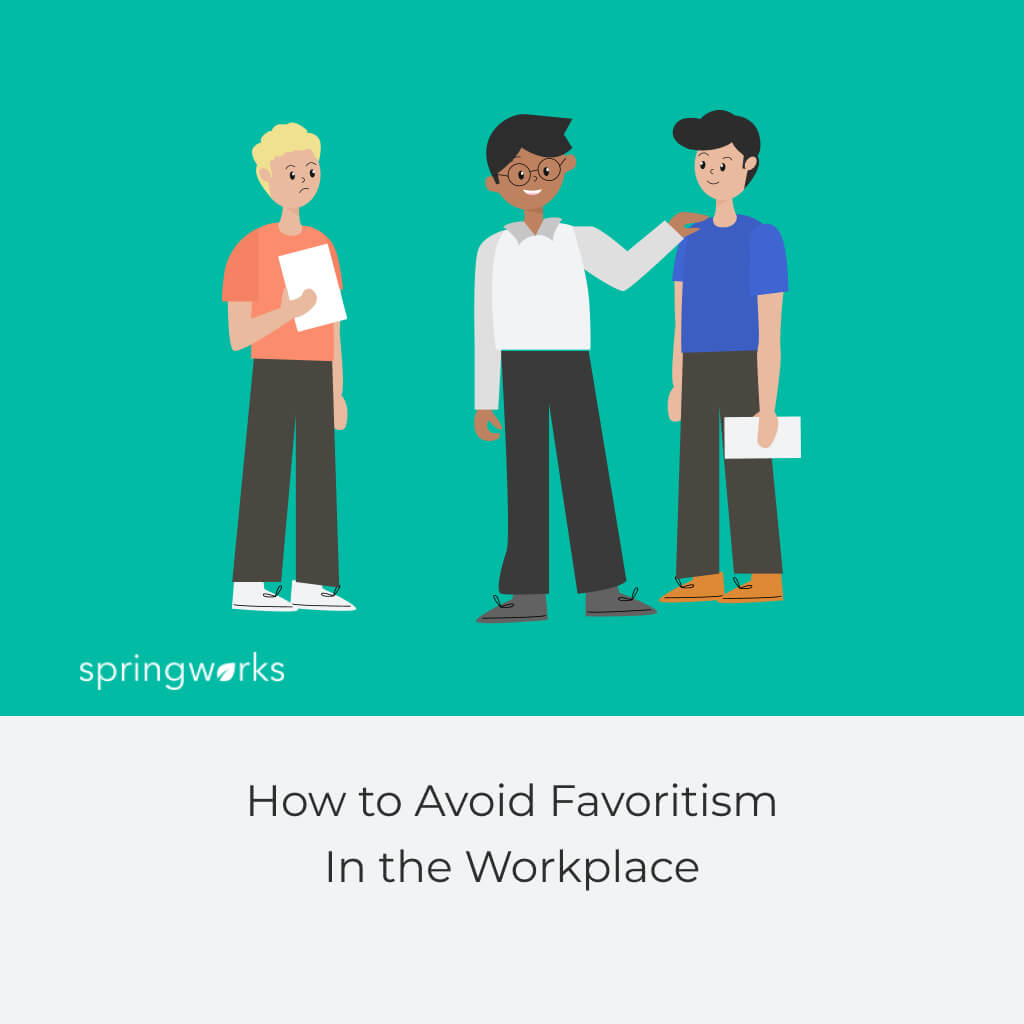
| Direct Answer, What is favoritism in the workplace? Workplace favoritism (also called partiality or playing favourites) is when a manager or employer gives preferential treatment to certain employees based on personal relationships, similarity, proximity, or other non-performance factors, rather than merit, qualifications, or results. It includes unequal task distribution, biased promotions, selective recognition, and inconsistent accountability. It is not illegal in most cases, but it is one of the most damaging forces in workplace culture: 63% of employees report feeling demotivated when they perceive favoritism, and 82% say they work in an unfair environment. |
Workplace favoritism is one of the most pervasive and least discussed management failures. It rarely shows up in exit interviews because employees feel it cannot be proven. It rarely appears in engagement surveys because employees assume nothing will change if they report it. Yet it quietly destroys the trust, morale, and performance that organisations invest enormous resources in building.
| 56% of executives admit to playing favourites in promotion decisions. 47% of employees believe their manager has a clear favourite on the team. Employees in high-fairness environments perform 26% better than those in low-fairness ones.Sources: Peoplelink Group 2025; Gartner research |
As Robert Whipple stated: ‘Leaders who practice favoritism in the workplace have no chance to build a culture of trust.’ This guide addresses the full picture: what favoritism is, what types exist, how employees can identify it, and, most importantly, 10 evidence-based strategies managers and HR teams can use to prevent it. Because the cost of inaction is measurable: the Springworks employee retention statistics show that perceived unfairness is one of the top five drivers of voluntary resignation.
What Is Favoritism in the Workplace? Definition and the 5 Main Types
| Favoritism (or partiality) in the workplace: the practice of giving preferential treatment to one or more employees based on personal relationships, personality similarity, proximity, or shared background, rather than performance, qualifications, or merit. Synonyms include: partiality, playing favourites, nepotism (when family-based), cronyism (when friend-based). |
| Type of Favoritism | How It Manifests | Who Is Most Affected |
| Arbitrary / Relational | Manager treats employees better simply because they like them, same social background, shared interests, or personal friendship | Anyone outside the manager’s social circle |
| Performance-Based Bias | High performers receive disproportionate recognition, access, and opportunity, even when others contribute equally | Consistent performers whose work is less visible |
| Proximity Favoritism | Employees physically near the manager (or remote workers vs. office-based) receive more visibility and opportunity | Remote workers, distributed teams |
| Tenure-Based Bias | Long-term employees automatically get easier workloads, protection from accountability, or automatic promotion | New hires, younger employees, career changers |
| In-Group / Cultural Bias | Manager unconsciously favours employees who share their cultural background, nationality, or communication style | Minority employees, those with different communication styles |
All five types share a common root: decisions that should be merit-based are influenced by factors unrelated to performance. Understanding which type is present helps HR teams address it at the right level, some require policy changes, others require manager coaching, and some (especially in-group and cultural bias) require structural DEI investment.
Warning Signs and Examples of Favoritism in the Workplace
| Most common signs of workplace favoritism: consistent assignment of high-profile projects to the same employees, unequal enforcement of rules and attendance policies, preferential feedback (private praise vs. public criticism), inner-circle social dynamics that exclude some team members, and promotion decisions that cannot be explained by performance metrics. |
Favoritism in the workplace does not usually announce itself. It shows up in the accumulation of small decisions that, individually, seem defensible but collectively reveal a pattern. Here are the most common warning signs:
• Unequal project assignment: The same 2–3 employees always receive the visible, high-impact projects. Others are given routine tasks regardless of capability or availability.
• Inconsistent accountability: A favoured employee’s late deliverables, policy breaches, or poor conduct are overlooked or privately addressed. The same behaviour from others triggers formal action.
• Selective recognition: Recognition is concentrated on the same employees, regardless of whether others have performed equally well or better. Only one person is thanked publicly after a team win.
• Inner circle dynamics: A manager consistently socialises with, confides in, or mentors the same subset of employees, creating a two-tier culture of insiders and outsiders.
• Opaque promotion decisions: Promotions happen without clear criteria being communicated in advance. High performers are passed over without explanation while less senior employees with closer manager relationships advance.
• Credit redistribution: A junior or favoured colleague receives credit for work primarily delivered by another team member. Ideas from non-favoured employees are ignored until the same idea comes from the manager’s favourite.
These warning signs often surface in work culture survey data before they escalate to formal employee complaints. Identifying them early is significantly cheaper, financially and culturally, than managing the attrition and legal risk that develops when they are ignored.
The Real Cost of Workplace Favoritism: Impact on Culture and Business
| 63% of employees feel demotivated and devalued when they perceive favoritism. A Journal of Applied Psychology study found favoritism causes a 25% decline in team cohesion. Employees in high-fairness environments perform 26% better. 29% more collaboration in inclusive workplaces.Sources: Workforce Institute; Journal of Applied Psychology; Gartner; Guider research |
Favoritism damages culture from the inside out. The employees who are not favoured do not leave immediately, they disengage first. The Springworks quiet burnout research shows that the silent disengagement driven by perceived unfairness often precedes resignation by 6–12 months, giving organisations ample time to intervene, if they have the measurement systems to detect it.
The cascade effect is predictable: perceived favoritism → reduced motivation → lower output quality → team cohesion decline → top performers seeking fairer environments → attrition. Each step is measurable. The organisations that break this chain early do so through proactive culture measurement and consistent management accountability, not reactive HR intervention after people have already resigned.
The strongest cultural protection is building a sense of belonging that is structurally independent of any single manager, where employees feel valued by the organisation, not just by their direct line manager.
How to Avoid Favoritism in the Workplace: 10 Evidence-Based Strategies
| 10 ways to prevent favoritism in the workplace: 1. Track project and opportunity distribution systematically 2. Define and publish recognition criteria before giving recognition 3. Use structured, objective performance review frameworks 4. Rotate leadership opportunities across the team 5. Recognise consistently, not just high performers 6. Appreciate routine excellence, not just extraordinary results 7. Recognise the action, not just the person 8. Build a reward system grounded in measurable criteria 9. Break inner circle dynamics deliberately 10. Create anonymous feedback channels for employees to flag patterns |
1. Track Project and Opportunity Distribution Systematically
The most effective structural intervention against arbitrary favoritism is a simple one: keep a record. Track which employees have been assigned to lead presentations, taken to client meetings, chosen as team leads, or given high-visibility projects over any rolling 90-day period. This data makes unconscious bias visible to the manager themselves. One of the most common HR challenges is that favouritism is genuinely unintentional, managers are not aware of the pattern until they see the data. Improving communication skills in performance conversations helps managers explain and justify their distribution decisions openly.
2. Define and Publish Recognition Criteria Before Giving Recognition
If employees do not know the criteria for recognition before it is given, recognition will always appear arbitrary, even when it is not. Define what specific behaviours, outcomes, or contributions merit recognition and communicate those criteria to the team in advance. This single practice eliminates the most common appearance of favoritism: the situation where one employee is praised without others understanding why. The employee recognition guide covers how to build criteria-based recognition programmes that the entire team understands and respects.
3. Use Structured, Objective Performance Review Frameworks
Subjective performance reviews are one of the primary institutional mechanisms through which favoritism compounds. Replace vague, impression-based evaluations with structured frameworks tied to measurable deliverables, observable behaviours, and pre-agreed goals. The performance review phrases guide provides the language framework for managers to give specific, evidence-based feedback rather than impression-based assessments.
4. Rotate Leadership Opportunities Across the Team
One of the most visible forms of favoritism is the consistent assignment of leadership roles, presenting to clients, leading the weekly meeting, heading the project, to the same people. Deliberate rotation ensures every team member develops leadership skills and visibility. It also surfaces hidden talent: the employees who have never been given the opportunity to lead often perform remarkably well when given it. Strong high-performing teams are built when every member has experienced both leading and supporting.
5. Be Consistent and Frequent With Recognition, Across the Whole Team
If the same 2–3 employees receive 80% of the team’s public recognition, every other team member notices. Frequent and inclusive recognition is one of the most visible and reliable signals of fairness. Use peer-to-peer recognition tools like EngageWith to distribute recognition organically beyond the manager’s direct line of sight, enabling colleagues to acknowledge each other’s contributions in real time via Slack and Microsoft Teams. The peer-to-peer recognition guide shows how this democratises acknowledgment and removes the bottleneck of manager-only recognition.
6. Recognise Routine Excellence, Not Just Extraordinary Results
Some roles require excellence in execution rather than innovation. The person who ensures client documentation is perfectly maintained, the coordinator who makes every meeting run smoothly, the support team member who resolves queries faster than anyone, these contributions are invisible until they stop happening. Recognising them explicitly signals that value is not determined by glamour or seniority, but by contribution. Consistent recognition of ‘doing the job well’ measurably improves morale among employees whose roles are structural rather than strategic.
7. Recognise the Action, Not Just the Person
Recognising what a person did, specifically and publicly, is more powerful than recognising who they are. ‘The way Priya handled the client escalation on Tuesday showed exactly the approach we value here: calm, specific, solution-oriented’ is fundamentally more defensible than ‘Priya is great.’ The specificity makes it harder for other employees to interpret the recognition as personal favouritism, and simultaneously teaches the team what excellent behaviour looks like. The employee rewards and recognition guide covers how to structure action-based recognition programmes.
8. Build a Reward System Grounded in Measurable Criteria
A structured reward system with published criteria, work accuracy, attendance, efficiency metrics, goal completion rates, customer satisfaction scores, removes the subjectivity that enables favoritism to operate. Employees who understand the criteria for rewards cannot reasonably argue that the system is unfair when those criteria are consistently applied. The HR policies guide provides the templates for building reward systems that are both defensible and motivating. Evaluate employees against the same scale for work accuracy so that no one believes the standards are being applied selectively.
9. Actively Break Inner Circle Dynamics
An inner circle is not always intentional, it forms naturally when managers spend more time with, confide in, or socialise with certain employees. The solution is deliberate counter-behaviour: make a point of having one-on-one check-in conversations with every team member on a rotating basis, not just the ones who naturally seek you out. The importance of respect in the workplace guide covers how behavioural patterns signal respect or its absence, often before the manager is aware of what they are communicating.
10. Create Anonymous Feedback Channels for Early Detection
Most employees who perceive favoritism will not raise it formally, the career risk feels too high. Anonymous feedback channels, run through EngageWith’s anonymous feedback feature, give employees a safe route to surface patterns before they escalate into disengagement, attrition, or formal grievance. Running regular work culture surveys with specific questions about fairness and equity gives HR teams the early warning data needed to coach managers proactively.
What to Do If You Are Experiencing Favoritism at Work
| If you believe you are experiencing favoritism: document specific incidents with dates, participants, and outcomes. Look for patterns over time, one incident is not favoritism; a consistent pattern is. Raise it informally with your manager first, unless the manager is the source of the favoritism. If informal resolution fails, use your organisation’s formal complaint process. If you need to escalate to HR, see the employee complaints guide for the step-by-step process. |
The challenge with proving favoritism is that individual decisions are usually defensible in isolation. What makes a favoritism case compelling is a documented pattern: the same employee always receives the high-visibility projects (dates recorded), the same person’s conduct violations are consistently overlooked (dates recorded), and your own equally strong performance has gone unacknowledged (dates, specifics). For the step-by-step process for raising workplace concerns formally, the employee complaints against managers guide covers every stage of the escalation process. If you believe the favoritism crosses into discrimination territory (based on race, gender, age, or religion), consult an employment attorney.
Frequently Asked Questions
What is the difference between favoritism and partiality?
Favoritism and partiality mean the same thing in a workplace context, both describe the preferential treatment of one employee over others based on personal relationships, similarity, or proximity rather than merit or performance. ‘Partiality’ is the more formal or legalistic term (common in South Asian professional English usage), while ‘favoritism’ (or ‘favouritism’ in British/Commonwealth spelling) is the more widely used term in Western HR and management contexts. Both describe the same pattern of biased decision-making.
What are the most common examples of favoritism in the workplace?
The six most commonly reported examples of workplace favoritism are: consistently assigning high-profile projects to the same employees, giving performance bonuses or promotions based on personal relationships rather than results, overlooking rule violations by favoured employees while disciplining others for the same behaviour, providing preferential access to resources, training, or flexible schedules, recognising the same team members repeatedly while ignoring equal contributions from others, and crediting favoured employees for work primarily done by their colleagues. For strategies on responding to each of these, the employee motivation guide covers how fair treatment is one of the strongest intrinsic motivators available.
What ensures managers avoid favoritism?
The four most reliable structural protections against manager favoritism are: rotating project assignments and leadership opportunities so no individual dominates high-visibility work; objective performance metrics defined before evaluation rather than after; transparent promotion criteria published to the entire team before any decision is made; and structured peer and 360-degree feedback systems that surface perceptions of unfairness before they become attrition. The combination of structural transparency and anonymous feedback channels is consistently more effective than relying on individual manager goodwill.
How do you address favoritism in the workplace as a manager?
The most effective managerial responses are proactive, not reactive. Start by auditing your own behaviour: Who have I assigned leadership roles to in the last quarter? Who have I recognised publicly? Who have I had meaningful 1-on-1 conversations with? The data usually reveals unconscious patterns before anyone raises a formal concern. Then build structural safeguards: criteria-based recognition, rotated assignments, and regular anonymous pulse surveys via tools like EngageWith. The goal is removing the subjectivity that allows favoritism to develop, not just suppressing the visible behaviour.
Can favoritism in the workplace become illegal?
Favoritism itself is not illegal in most jurisdictions. However, when preferential treatment is based on protected characteristics, race, gender, religion, age, national origin, disability, it becomes discrimination and is illegal under employment law in most countries. If favoritism consistently disadvantages employees from protected groups (women are always passed over for promotion in favour of men, for example), it can form the basis of a discrimination claim. For the full process of raising workplace concerns formally, the employee complaints against managers guide and the HR policy templates are the most relevant resources.
Final Thoughts
Workplace favoritism costs organisations in every direction simultaneously: it demotivates non-favoured employees, creates legal risk, erodes the trust that makes teams perform, and, ultimately, drives away the high performers who have the most options.
The good news is that it is almost entirely preventable, not through policing manager behaviour, but through building systems and structures that make fairness the path of least resistance. Objective criteria, transparent processes, consistent recognition, and anonymous feedback channels collectively remove the conditions under which favoritism develops. For the tools that make these systems practical at any organisation size, EngageWith integrates recognition, anonymous feedback, and culture surveys directly into Slack and Teams making fairness infrastructure as accessible as a daily Slack message. For the broader framework on building a culture where fairness thrives, the employee engagement strategies guide and the building belonging guide are the most relevant next reads.

Attract top talent and keep your best employees with reward and recognition, communications, surveys and more