| Direct Answer: Having fun at work is important because it directly improves productivity, reduces burnout, boosts creativity, strengthens team bonds, and increases employee retention. Research from Oxford University shows happy employees are 13% more productive. A 2025 meta-analysis confirms fun at work significantly reduces burnout and raises engagement. It is not a distraction from work; it is what makes sustained, high-quality work possible. |
The average person spends over 90,000 hours of their life at work. That is roughly one-third of every waking hour between graduation and retirement. Given that reality, the question is not whether work should be enjoyable; it is whether organisations can afford to ignore the evidence that it should be.
Fun at work is not about free lunches and foosball tables. It is a cultural philosophy backed by decades of research showing that workplaces where people laugh, play, connect, and genuinely enjoy spending time together produce measurably better business outcomes. A 2025 meta-analysis published in a peer-reviewed psychology journal confirmed that fun at work significantly reduces employee burnout and raises engagement across industries and geographies.
At Springworks, consistently ranked among India’s best places to work, fun is embedded into the culture deliberately, not accidentally. We have seen firsthand how the right combination of activities, recognition, and a safe environment to be human at work transforms team performance. This guide covers the seven most important benefits of fun at work, backed by research, and 10 specific ideas HR teams and managers can implement immediately. For a direct comparison, 90% of highly engaged employees say they work on a fun team, versus only 37% of disengaged employees.
What Does Having Fun at Work Actually Mean?
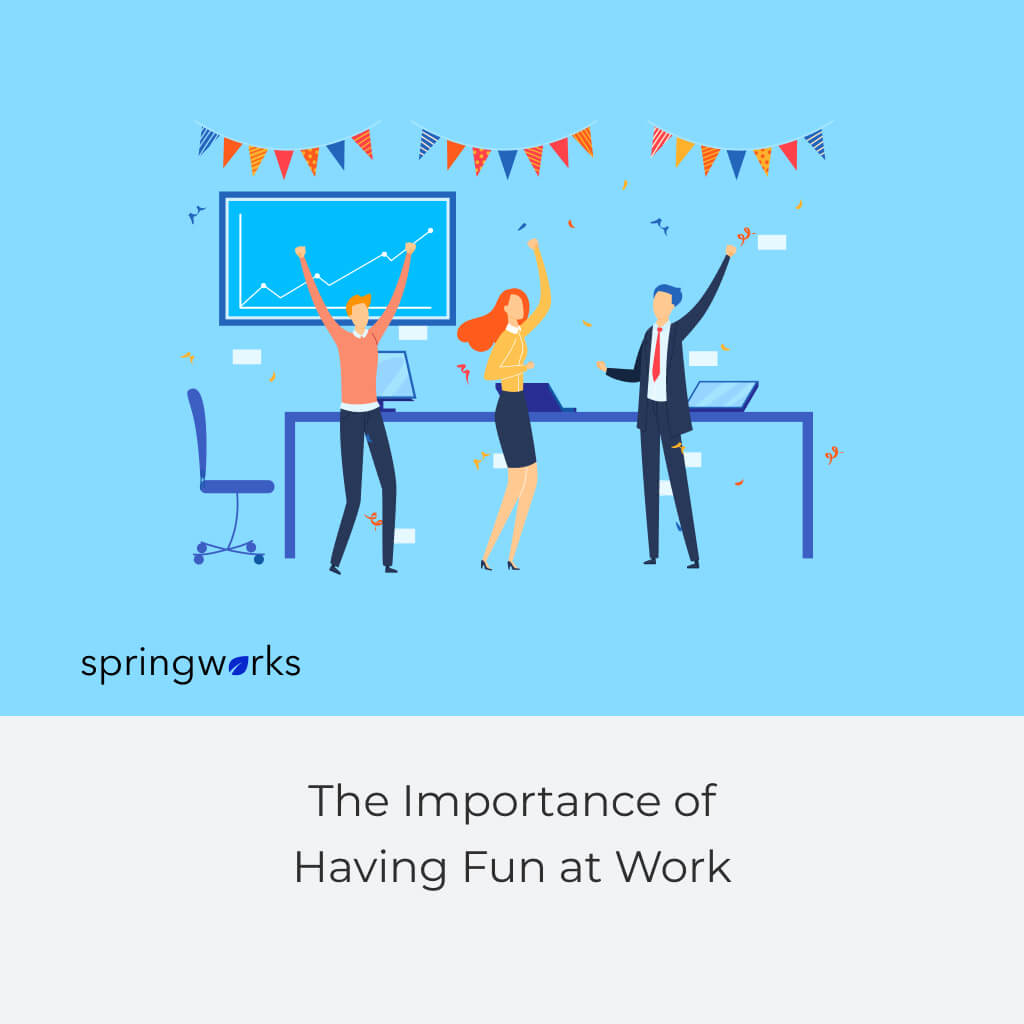
| Having fun at work means creating an environment where employees feel genuine positive emotion during their workday through laughter, playful interactions, shared experiences, games, team activities, and celebrations. It does not mean the absence of serious work. It means that serious work happens within a culture that values human connection, lightness, and enjoyment making that serious work more sustainable and effective. |
Researcher Karl Rohnke’s definition is precise: workplace fun is ‘the state of having experiences that produce spontaneous laughter and smiles, generate positive emotions, and create a sense of shared enjoyment.’ Research published in the Journal of Vocational Behavior found it is not necessarily the fun activities themselves that drive better outcomes; it is the fun atmosphere that creates the psychological conditions for growth.
Why Fun at Work Matters: 7 Research-Backed Benefits
| The 7 key benefits of fun at work are: higher productivity (13% increase per Oxford University), improved creativity (31% more creative with a positive mindset per HBR), stronger collaboration, better mental health and lower burnout, higher job satisfaction and retention, reduced absenteeism, and measurably higher profitability (21% per Gallup). |
1. Fun Makes Employees Significantly More Productive
| Happy employees are 13% more productive and in some cases up to 20% more productive than their less happy peers. 82% of workers say feeling happy and engaged at work is the key driver of their productivity.Sources: Oxford University / University of Warwick (Oswald, Proto, Sgroi); Slack State of Work 2025 |
The mechanism is direct: positive emotions broaden attentional focus, reduce decision fatigue, and increase willingness to engage fully with tasks. A University of Warwick study placed happy employees in controlled productivity trials and found consistent output improvements. When employees enjoy their environment, they are not distracted by discomfort; their cognitive bandwidth is available for the work itself. Pair this with strong employee engagement strategies, and the productivity gains compound.
2. Fun Fuels Creativity and Innovation
A positive mindset makes employees 31% more creative than a neutral or negative one. When teams are having fun, their brains release dopamine and serotonin neurotransmitters associated with open-minded thinking, pattern recognition, and creative problem-solving. The fixed routine of daily work without play compresses creative possibility; introducing fun activities, challenges, games, and competitions reopens it. University of Florida research found that workplace fun specifically increases employees’ job engagement, creativity, and organisational citizenship behaviours like helping co-workers.
3. Fun Strengthens Team Communication and Collaboration
Enjoying time together outside of task contexts removes the professional barriers that normally prevent employees from asking for help, sharing half-formed ideas, or admitting a mistake. Gallup research found that employees with a best friend at work are twice as likely to be engaged as those without. When people genuinely like their colleagues built through shared laughter, games, and social experiences, they communicate more honestly, trust each other more readily, and produce better collaborative output. The benefits of team building activities guide documents 15 specific ways this dynamic improves team performance.
4. Fun Reduces Burnout and Protects Mental Health
| A 2025 peer-reviewed meta-analysis confirmed that fun at work significantly reduces burnout and raises work engagement. Only 33% of global employees reported thriving wellbeing in 2025, down from prior years, making fun an urgent, not optional, culture investment.Sources: Tandfonline 2025 meta-analysis; Gallup State of the Global Workplace 2025 |
The connection between fun and burnout prevention is physiological as well as psychological. Laughter triggers the release of oxytocin and endorphins, reducing cortisol (stress hormone) levels and restoring cognitive capacity that stress depletes. In the Springworks quiet burnout research involving thousands of employees across industries, a lack of social connection and joylessness at work were consistently among the earliest signals of the disengagement that precedes voluntary resignation. Fun is not a luxury for burnout prevention; it is one of the cheapest and most scalable protective mechanisms available.
5. Fun Increases Job Satisfaction and Retention
According to Gallup’s meta-analysis, companies with a highly committed and satisfied workforce are 21% more profitable. Employees who work in environments they genuinely enjoy are more committed to the organisation, more willing to go beyond their defined responsibilities, and significantly less likely to actively seek other opportunities. Fun at work is one of the key conditions that determines whether employees feel a sense of belonging, the deepest driver of long-term loyalty that engagement scores alone cannot capture. For the full picture on how satisfaction translates into retention, the job satisfaction guide provides the research framework.
6. Fun Reduces Absenteeism and Sick Days
UK businesses lose an average of 6.9 days per employee annually to absenteeism, at an estimated cost of £554 per employee. Employees who enjoy their workplace environment are measurably less likely to call in sick not because their physical health is automatically better, but because they are less stressed, more resilient, and more motivated to show up. Social connection at work built through fun also creates a sense of responsibility toward teammates that raises attendance independent of any monitoring system.
7. Fun Is a Competitive Employer Brand Advantage
In Fortune’s ‘Great Places to Work’ research, employees at companies rated as ‘great’ not just ‘good’ described their workplace as fun at a rate of 81% versus 62%. In an era where employer brand is built on Glassdoor reviews and LinkedIn posts, a workplace people genuinely enjoy is a recruitment asset that compounds over time. Organisations that motivate employees through culture and recognition consistently attract better-fit candidates at lower cost.
How to Create a Fun Work Environment: 10 Practical Ideas
| To create a fun work environment: (1) introduce regular games and activities, (2) build social time outside of tasks, (3) recognise milestones consistently, (4) create team challenges and competitions, (5) run wellness initiatives, (6) encourage humour and psychological safety, (7) celebrate wins publicly, (8) use peer recognition tools, (9) offer mindfulness breaks, (10) give employees ownership of fun. The key is that fun must be embedded in culture — not reserved for one annual event. |
1. Run Regular Team Games and Activities
Studies show games reduce stress, build interpersonal trust, and increase the felt sense of team belonging. You don’t need a budget for a foosball table; a 20-minute virtual or in-person game achieves the same psychological effect. Tools like EngageWith by Springworks run directly in Slack and Teams, making micro-fun frictionless any day of the week. For a curated library of activities, the remote games and activities guide and the ultimate team building activities guide cover both in-person and virtual formats.
2. Create Opportunities for Socialising Outside of Work Tasks
Team lunches, virtual coffee chats, annual meetups, sports outings, and off-site retreats create the informal relationship contexts where real trust and friendship form. When people are friends with their coworkers, not just colleagues, they communicate more honestly and cover for each other more readily. The virtual icebreakers guide provides 200+ options for distributed teams.
3. Recognise Milestones, Both Professional and Personal
High-five emails, social media shout-outs, handwritten notes, surprise time off, walls of fame, and public celebration of birthdays and work anniversaries are all low-cost, high-impact expressions of the organisation’s care for its people. Celebrating milestones and work anniversaries signals that employees matter as people, not just as producers. Use EngageWith to let any employee send Kudos or Shout-outs to any colleague in real time, the recognition that sustains motivation between formal milestones.
4. Introduce Friendly Competitions and Team Challenges
Competitions, hackathons, scavenger hunts, cooking contests, or trivia championships channel the competitive energy in any team into something that bonds rather than fragments. The key design principle: competitions that pit teams against each other (not individuals) build cohesion. Structure them around skills relevant to the role for maximum dual benefit. Find the full activity library in the team building guide and the team building activities for remote teams guide.
5. Invest in Wellness and Make It Genuinely Fun
A health seminar is not fun. A steps challenge with a leaderboard, a team yoga session, or a monthly fitness competition where teammates keep each other accountable those are. According to Inc, businesses see an average ROI of $5.81 for every $1 invested in employee wellness. Workplace fitness challenges have been one of the highest-engagement interventions at Springworks. Pair with employee wellness programme ideas for a complete framework.
6. Build Psychological Safety for Humour and Playfulness
Fun cannot be mandated. It requires an environment where people feel safe enough to be silly, make mistakes, and laugh at themselves without social risk. Managers who model this, acknowledging their own errors with humour, participating in team games rather than observing them, and sharing appropriate personal stories, create the permission structure that allows genuine fun to emerge. This is directly related to the psychological safety that underpins high-performing teams.
7. Celebrate Wins Publicly and Specifically
Recognition is one of the fastest ways to create positive emotion at work. When wins are celebrated, specifically ‘the way you handled that client call last Tuesday showed exactly the composure we’ve been building toward,’ the recipient feels seen and valued, and the whole team learns what great looks like. Use employee recognition and appreciation ideas and employee rewards and recognition programmes to systematise this.
8. Use Peer Recognition to Democratise Fun
Fun generated by leadership is top-down and limited. Fun generated by peers is organic and unlimited. Peer-to-peer recognition, where any employee can acknowledge any colleague’s contribution, creates a culture of appreciation that reaches the whole team, not just those in the manager’s line of sight. The EngageWith guide explains how to build this into daily Slack and Teams workflows for maximum cultural penetration.
9. Introduce Mindfulness Breaks as Part of the Workday
A monthly laughter yoga session, a team meditation, or even a designated ‘no-meetings afternoon’ signals that the organisation values mental recovery as much as output. Research shows meditation training improves focus and reduces the tendency to distraction outcomes that have direct productivity implications. Frame these as fun, not mandatory wellness compliance, and participation will be enthusiastic.
10. Give Employees Ownership of the Fun Culture
The most sustainable fun cultures are employee-driven, not HR-managed. Create a Fun Committee, give it a small quarterly budget, and let employees choose and run the activities they actually want. This approach generates far higher participation than corporate-mandated events, builds additional leadership skills in the committee members, and sends a powerful signal of organisational trust in employee judgment. Capture the impact through regular employee engagement pulse surveys and iterate accordingly.
How to Make Work Fun for Remote and Hybrid Employees
Remote fun requires replacing the ambient social energy of physical co-location with deliberate, designed alternatives. The best approaches: weekly virtual trivia, virtual happy hours, async recognition via EngageWith, digital social channels (#random, #wins, #pets), and quarterly in-person meetups for relationship-building. The principle is the same as in-person fun: create shared positive experiences. The format adapts; the intent does not. For remote-specific activity ideas, see the remote team building activities guide and the work-life balance guide for distributed teams.
Frequently Asked Questions
Why is having fun at work important?
Fun at work is important because it directly improves the conditions that determine business performance: productivity increases by up to 13% (Oxford University), creativity by 31% (HBR), and team collaboration measurably improves when employees feel genuine positive emotion at work. A 2025 meta-analysis confirms fun significantly reduces burnout. Organisations on Fortune’s ‘Best Places to Work’ list have employees who describe their workplace as fun at an 81% rate versus 62% at ‘good’ companies.
How do you make work more fun for employees?
The most effective approaches are: regular team games and challenges, peer recognition via platforms like EngageWith, milestone celebrations, social time outside of task contexts, wellness challenges, and giving employees ownership of the fun culture through a Fun Committee. The key insight from the Journal of Vocational Behavior: it is the fun atmosphere, not any specific activity, that drives lasting outcomes.
What are the benefits of having fun at work?
The seven most research-backed benefits of workplace fun are: higher individual productivity (Oxford University), greater creativity (HBR), stronger team communication and collaboration (Gallup), reduced burnout and lower stress (2025 meta-analysis), increased job satisfaction and retention (Gallup profitability data), lower absenteeism, and a stronger employer brand. All seven stem from the same root: positive emotions at work create the conditions for sustained, high-quality performance.
Can work be fun and productive at the same time?
Yes, and research suggests it is more productive when it is fun. The misconception that fun and productivity are in competition comes from a narrow definition of productivity as ‘time on task.’ Modern research on cognitive performance, creativity, and team effectiveness consistently shows that employees who enjoy their work environment produce better outcomes on every dimension not just faster outputs, but higher quality thinking, stronger collaboration, and greater resilience under pressure.
How often should companies run fun activities at work?
Research and practitioner experience suggest: micro-fun (games, peer recognition, team jokes) embedded daily; structured activities (team lunches, competitions, social events) monthly; and major team events (retreats, annual outings) quarterly or annually. The compound effect of regular, low-effort fun rather than sporadic, high-budget events is what shifts culture. For a complete activity calendar, the ultimate team-building activities guide provides options at every frequency and budget level.
Final Thoughts
Fun at work is not a distraction from the business. It is what makes the business work sustainably, at scale, across the full talent lifecycle from attraction to retention. The research is unambiguous, the business case is clear, and the implementation is more accessible than most organisations realise.
The organisations that get this right, Springworks among them, do not treat fun as a perk they offer when things are going well. They treat it as a structural investment in the psychological conditions that make everything else possible: creativity, trust, resilience, and the willingness to give discretionary effort when it matters most. Start with two or three ideas from the list above. Build the habit. Measure it with employee engagement surveys. And let the data show you what your employees already know: work is better when it is also, occasionally, genuinely fun.